Selecting the correct Hospital Wall Protection Materials requires matching them to each area's impact risk, hygiene needs, and design goals. Trusted customization insights from PINGER help facility managers avoid costly mistakes. These insights enable durable, compliant solutions tailored to specific zones.
Assess each hospital area's impact and hygiene needs to choose the right wall protection.
Compare materials like stainless steel and vinyl to balance cost and durability.
Check performance factors such as impact resistance and fire ratings for safety.
Facility managers must map every zone before selecting hospital wall protection materials. Emergency departments, operating room corridors, and patient transport routes absorb constant impact from gurneys, wheelchairs, and supply carts. These areas demand the best wall protection for hospitals — products engineered for repeated strikes without cracking or denting.
Different zones carry different risk levels. A waiting room wall faces occasional chair scuffs. A radiology hallway endures heavy equipment collisions daily. Teams should walk each floor and note where carts turn, where doors swing open, and where beds park against walls. This walkthrough reveals where impact resistant wall covering healthcare products are mandatory and where standard finishes suffice.
Infection control drives material choice as much as physical durability. The CDC classifies walls as housekeeping surfaces with minimal hand contact, meaning they need less frequent cleaning than high-touch items like doorknobs and bedrails. Walls require cleaning only when visibly soiled.
CDC guidelines divide environmental surfaces into medical equipment surfaces and housekeeping surfaces (floors, walls, tabletops). Housekeeping surfaces are further split into minimal hand-contact (low-touch) and frequent hand-contact (high-touch) surfaces.
This distinction matters for healthcare wall covering options. Products near toilets or privacy curtains need stronger disinfectant compatibility. The CDC does not recommend disinfectant fogging for routine patient-care areas. When asking what material is used for hospital walls, buyers should confirm the finish withstands the facility's approved cleaning agents without degrading.
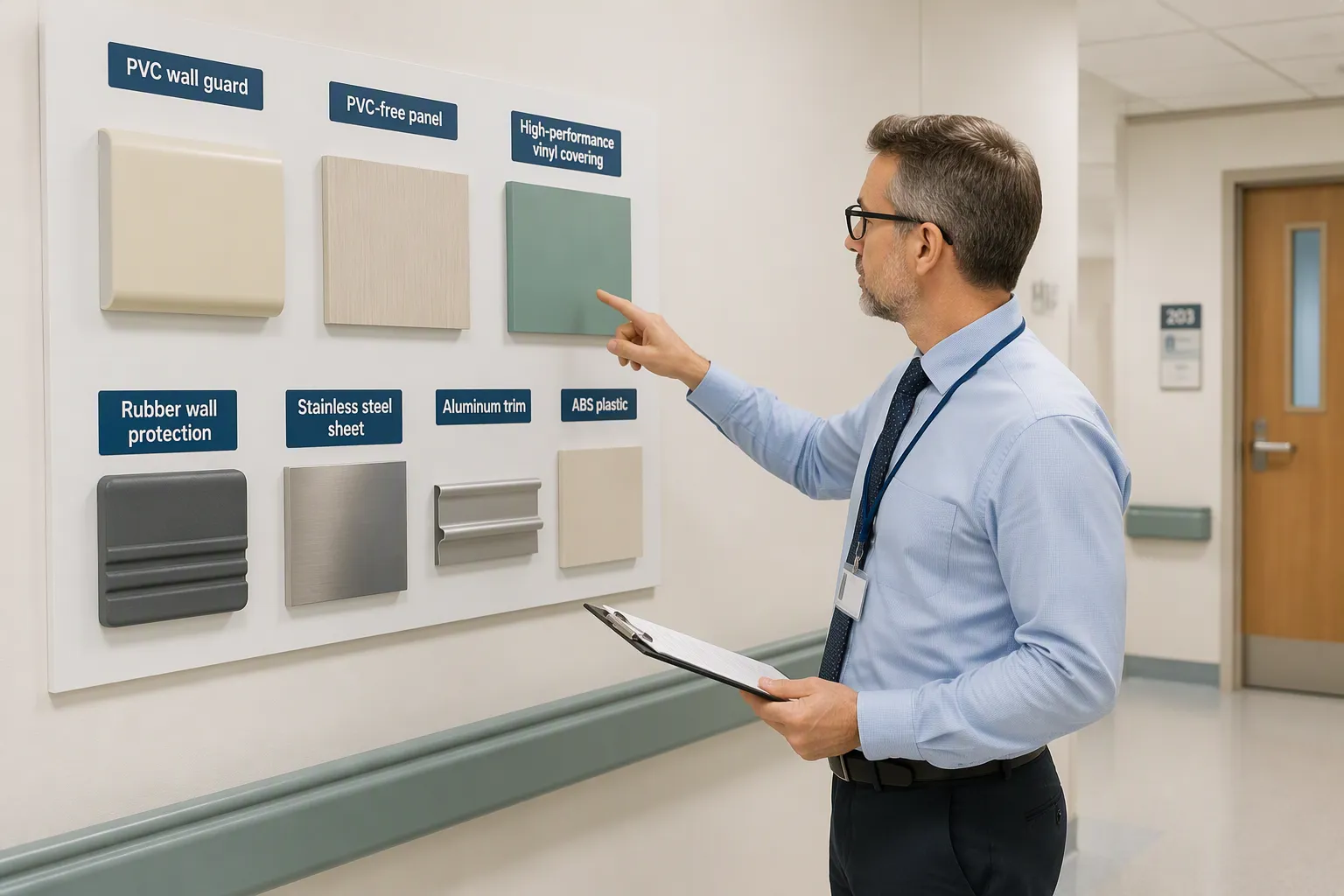
Every hospital zone demands a different material. Emergency corridors require heavy-duty stainless steel. Patient rooms can use softer vinyl. A facility manager must match the Hospital Wall Protection Materials to the impact level, cleaning protocol, and budget of each area. High-performance vinyl and aluminum dominate hospital-grade protection due to durability and long-term value. Selecting the right combination controls costs while meeting performance requirements.
PVC wall guards offer an affordable entry point at $40–$80 per meter. They suit moderate-use areas such as waiting rooms or administrative corridors. PVC materials absorb light impacts and resist common cleaning chemicals used daily in healthcare environments. However, they require replacement two to five times over five years. Maintenance crews incur additional costs for repair labor and replacement parts.
PVC-free alternatives meet sustainability goals without sacrificing performance. These products avoid chlorine-based compounds and qualify for LEED certification. They perform comparably to PVC in impact tests and accept the same disinfectants.
High-performance vinyl delivers greater durability for moderate-traffic zones. Manufacturers reinforce vinyl with fabric backings or fiber layers to create impact resistant wall covering healthcare facilities rely on for long service life. Vinyl accepts vibrant colors and patterns that support wayfinding goals without compromising cleanability. Healthcare wall covering options often rank vinyl as a top choice for balancing cost with longevity.
Rubber wall protection absorbs impact effectively. It works well in mental health units where softer surfaces improve patient safety. Rubber handrails also offer slip resistance and comfort for patients with limited mobility.
Stainless steel delivers the highest durability among Hospital Wall Protection Materials. Facility managers specify stainless steel in high-impact zones such as emergency bays, trauma rooms, and equipment storage corridors. Upfront cost runs $120–$240 per meter. Replacements over five years rarely exceed one or two. Total five-year cost sits at $130–$260 per meter.
Stainless steel wall guard rails offer superior long-term cost efficiency and durability, while PVC provides budget-friendly protection for moderate-use hospital settings.
Aluminum offers a middle ground. It resists corrosion and weighs less than steel, easing installation in retrofit projects. ABS plastic provides cost-effective impact resistance for corner guards and bumper strips in patient rooms and nursing stations. ABS withstands frequent disinfection without warping.
Manufacturers often combine materials in single products. Wall guards may feature stainless steel caps over wood cores. Handrails pair aluminum brackets with vinyl covers. Corner guards use ABS for rigidity with vinyl wraps for aesthetics. This hybrid approach lets specifiers tailor Hospital Wall Protection Materials to each location. A single hospital may use stainless steel in the ED, vinyl in patient rooms, and rubber in behavioral health units.
|
Cost Factor |
Stainless Steel Wall Guard |
PVC Wall Guard |
|---|---|---|
|
Upfront purchase cost |
$120–$240 per meter |
$40–$80 per meter |
|
Maintenance needs |
Low: occasional cleaning |
Medium: frequent cleaning |
|
Replacements over 5 years |
Rare: at most 1–2 |
Frequent: 2–5 |
|
Total 5-year cost |
$130–$260 per meter |
$100–$220 per meter |
Impact resistance determines how well a product survives repeated strikes from carts, beds, and wheelchairs. Manufacturers test this property through hard-body and soft-body impact methods. Buyers should request test data rather than rely on marketing claims. A product rated for heavy impact suits the emergency department. A lighter rating fits an office or waiting area.
Durability extends beyond the first hit. Hospital wall protection materials must resist cracking, denting, and delamination across years of daily use. Stainless steel and aluminum hold their shape under heavy loads. Vinyl and rubber recover from deformation. PVC may crack at stress points after repeated contact. Facility managers should compare warranty terms against expected service life.
Fire ratings carry legal weight in healthcare construction. NFPA 101 classifies interior wall and ceiling finishes by flame spread index (FSI) and smoke developed index (SDI) under ASTM E84. Class A covers FSI 0-25 and SDI 0-450. Exit enclosures, corridors, and lobbies typically require Class A materials. Hospital stairwells count as exit enclosures. Class A protection is therefore generally required there. Specifiers should confirm every product's ASTM E84 classification before installation.
Scratches accumulate on any wall surface. Gurneys, cleaning equipment, and even jewelry leave marks over time. Scratch resistance depends on surface hardness and coating quality. Rigid materials such as stainless steel and aluminum resist scratching well. Vinyl with a protective topcoat performs better than untreated vinyl. Impact resistant wall covering healthcare products often include a clear protective layer for this reason.
Colorfastness matters for long-term appearance. Disinfectants, sunlight, and abrasion fade colors over time. Faded walls look worn and undermine wayfinding cues. Buyers should ask suppliers about color retention testing and cleaning-agent compatibility. A product that fades after one year of disinfection costs more to replace than a slightly pricier alternative that holds its color.
These two properties interact with the earlier material comparison. The best wall protection for hospitals balances impact strength, fire compliance, scratch resistance, and color stability in one specification. Healthcare wall covering options that pass all four checks deliver lower lifecycle costs. Facility managers should score each candidate against these criteria before committing to a purchase.
Color contrast performs a critical safety function in healthcare environments. Facility managers select hospital wall protection materials with colors that visually separate wall guards, handrails, and corner guards from surrounding surfaces. A dark vinyl corner guard against a light wall prevents patients and staff from bumping into protruding edges. This visual distinction reduces collision accidents in busy corridors.
Patients with low vision rely heavily on color contrast for safe navigation. The Americans with Disabilities Act recommends specific contrast ratios between adjacent surfaces. Manufacturers offer healthcare wall covering options in coordinated palettes that meet these accessibility requirements. A well-chosen color scheme reduces accident risk without adding material cost. The best wall protection for hospitals integrates safety features directly into the design rather than treating them as separate considerations.
Contrasting colors also highlight door frames, wall transitions, and equipment alcoves. Specifiers should verify that chosen colors maintain visibility under the facility's lighting conditions. Fluorescent and natural light can alter perceived contrast significantly.
Design must balance safety, aesthetics, and long-term value for the building. A hospital's color system helps visitors navigate complex floor plans. Color-coded corridors guide patients to radiology, pediatrics, or the emergency department. What material is used for hospital walls in these zones matters less than how the finish supports the wayfinding strategy.
Brand identity also influences material selection. A hospital may use its signature blue on corridor handrails or reception wall guards. This approach reinforces institutional identity while protecting high-traffic surfaces. Impact resistant wall covering healthcare products now come in extensive color ranges that accommodate branding without sacrificing durability.
Long-term value requires choosing colors that resist fading and remain appropriate over time. Neutral tones paired with accent colors offer flexibility for future rebranding. Manufacturers test colorfastness under repeated disinfection cycles. Specifiers should request this data before finalizing any design choice. A thoughtful color strategy reduces replacement frequency and maintains a professional appearance.
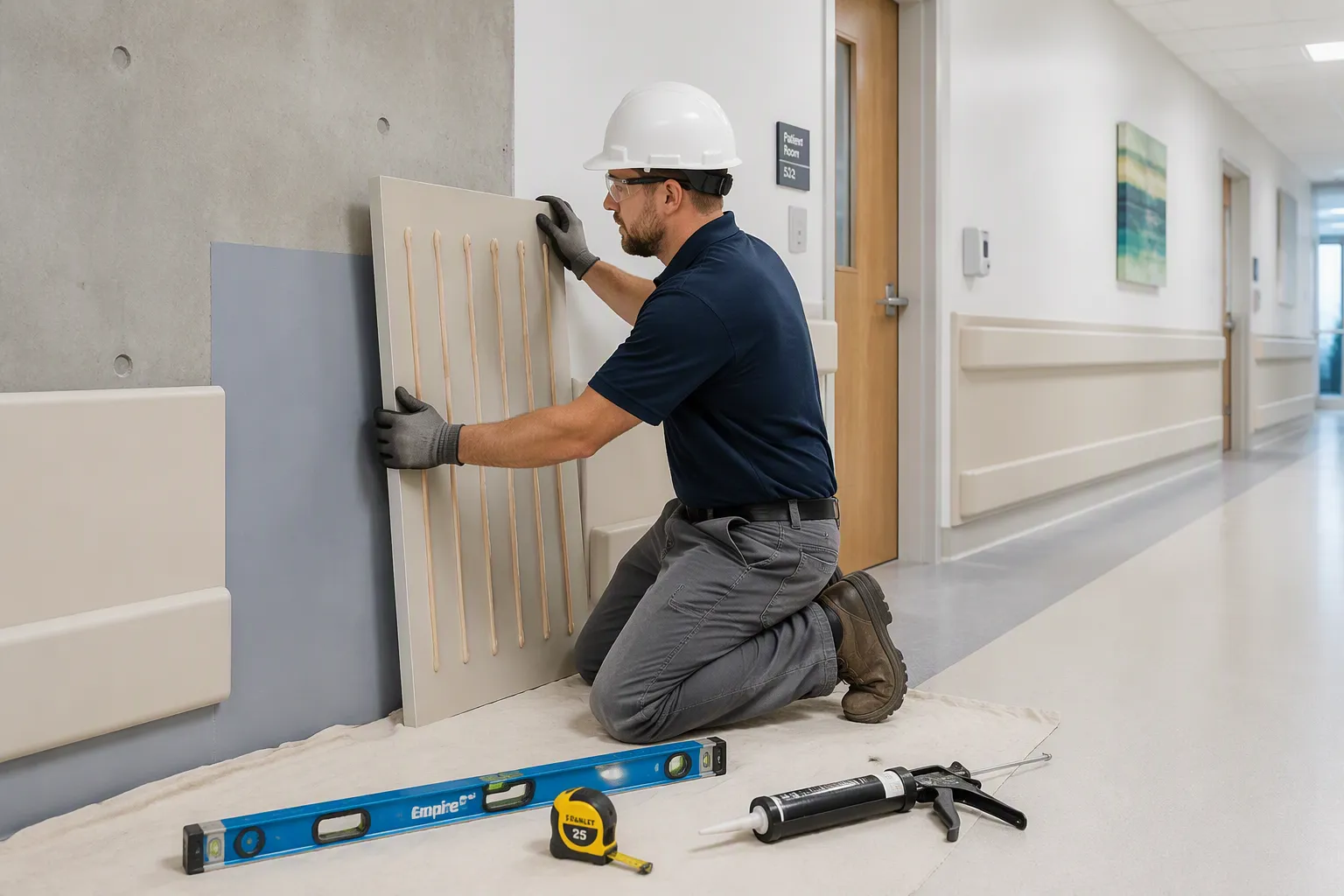
Installation quality determines whether hospital wall protection materials perform as specified. Premium panels installed incorrectly perform worse than budget materials installed properly. Poor adhesive application, improper seam sealing, inadequate substrate preparation, and wrong fastener selection all lead to premature failure regardless of material quality. These errors void warranties, create safety hazards, and force expensive do-overs that devastate project budgets.
Substrate preparation is critical for long-term adhesion. Surfaces must be clean, dry, structurally sound, and properly primed before installation. Installers must identify and address moisture issues, structural defects, and surface irregularities before panels are installed. Skipping these steps causes panels to telegraph imperfections, lose adhesion, or trap moisture, leading to mold growth and panel failure. The most common reasons these systems fail include:
Substrate contamination
Moisture vapor transmission
Inadequate surface preparation
Concrete coatings and drywall can deliver seamless, clean, impact-resistant surfaces, but the quality of the outcome is directly tied to the starting condition of the substrate. Transitions and terminations are where these systems most commonly fail. Monolithic surfaces do not forgive poor prep work. Proper installation depends on many factors, including close construction oversight. Slab conditions matter enormously for system performance.
Corners, door frames, and equipment alcoves demand special attention during installation. These transition points concentrate impact forces and often expose gaps where moisture or debris can enter. Installers should cut panels precisely to fit around door frames and outlet boxes. They must seal all edges and seams to prevent water infiltration behind the protection system.
Equipment mounting requires coordination between wall protection installers and medical equipment vendors. Wall guards must accommodate mounting brackets for dispensers, monitors, and bedside rails. Facility managers should provide installers with accurate equipment layouts before work begins. This planning prevents costly rework when equipment does not align with installed protection.
Understanding intent before specification and matching the finish to the actual use of the space are essential. A corridor corner guard installed without proper backing may loosen within months. A handrail mounted to a hollow wall may pull free under patient weight. Installers should verify substrate strength at every attachment point. They should also confirm that fasteners match the substrate type — concrete, drywall, or metal stud. Proper planning at these transition zones protects the facility's investment and maintains a safe environment for patients and staff.
Infection control teams clean walls daily with powerful agents. These chemicals attack hospital wall protection materials over time. Quaternary ammonia solutions, bleach, and alcohol-based disinfectants degrade the adhesives used in conventional wall coverings. Infection control teams confirmed this degradation in real healthcare settings.
Repeated exposure to harsh bleach concentrations or strong solvents accelerates cracking and discoloration in medical vinyl. Quaternary ammonium salts, isopropyl alcohol, ethyl alcohol, peroxide, and chlorine all degrade the wallcovering's coating. This damage worsens with frequent use or concentrations above manufacturer recommendations. Facility managers should verify chemical compatibility before selecting any healthcare wall covering options.
Damage inevitably occurs despite proper material selection. Facility managers need clear repair and replacement protocols. Minor scratches on vinyl or ABS may accept color-matched repair kits. Deep gouges in PVC often require full panel replacement. Stainless steel and aluminum typically need only surface polishing.
Facility managers should stock spare panels for high-impact zones. This practice reduces downtime when damage occurs. Replacement intervals depend on material type and traffic level. PVC may need replacement two to five times over five years. Stainless steel rarely needs more than one or two replacements in the same period. A proactive replacement schedule protects the facility's investment in the best wall protection for hospitals. Teams should document damage patterns to identify problem areas and adjust specifications accordingly.
Standard sizes rarely fit every corridor, alcove, or nurse station. PINGER manufactures hospital wall protection materials to exact project dimensions. Facility managers can specify panel lengths, heights, and thicknesses that match as-built conditions. This approach eliminates field cutting and reduces installation waste.
Color matching extends beyond a standard swatch book. PINGER offers custom color formulation to align with a facility's branding or wayfinding palette. Buyers can also request printed logos, department names, or directional graphics directly on wall guards and handrails. These healthcare wall covering options turn functional protection into a communication tool. A pediatric wing may carry playful graphics. A surgical corridor may display sterile-zone markers. Custom printing removes the need for separate signage and keeps surfaces easy to clean.
OEM programs let distributors and contractors private-label products under their own brand. PINGER supports this model with dedicated tooling and packaging. Buyers should confirm that custom colors and prints still meet the same fire and impact ratings as standard stock. Customization must never compromise the best wall protection for hospitals.
Custom orders take longer than stock items. Buyers should expect extended lead times for custom colors, printed graphics, and non-standard sizes. The exact duration depends on tooling requirements, order volume, and production scheduling. PINGER provides quoted lead times at the order stage so project teams can plan installation sequences.
Minimum order quantities vary by product line and customization level. Standard colors typically carry lower minimums than fully custom formulations. Printed logos and unique profiles usually require higher volumes to justify setup costs. Facility managers should consolidate orders across departments to meet these thresholds. Early coordination with the manufacturer prevents delays. Buyers who confirm what material is used for hospital walls before ordering avoid mid-project changes that reset lead times. A clear specification up front keeps impact resistant wall covering healthcare projects on schedule.
Certifications verify consistent quality processes. ISO9001 certification, which PINGER holds, signals production meets international quality management standards. Facility managers should request certification documentation before ordering any hospital wall protection materials.
Warranty periods reveal manufacturer confidence in product durability. These guarantees vary significantly across suppliers.
|
Manufacturer |
Warranty Period |
Certification |
|---|---|---|
|
Guangzhou Pinger Vinyl Material Co., Ltd. |
2-Year |
ISO9001 |
|
Guangzhou Shining Building Materials Co., Ltd. |
Lifetime |
CE |
|
Zhejiang Dingtian Traffic Facilities Co., Ltd. |
1 Year |
N/A |
A 2-year warranty demonstrates meaningful confidence. A lifetime warranty signals stronger durability claims. A 1-year warranty warrants scrutiny. Buyers should verify warranty coverage — material defects, installation failure, or color fade. They should also check supplier project history. A manufacturer with ten years of healthcare installations likely delivers reliable impact resistant wall covering healthcare products.
Quality extends beyond warranty terms. When evaluating what material is used for hospital walls, buyers should recognize that quality varies by manufacturer. They should request physical samples of healthcare wall covering options before committing. Samples reveal surface texture, edge finish, and color accuracy that photographs cannot convey. Facility managers should test samples with their facility's disinfectants.
Customer support matters when problems arise. A manufacturer that answers technical questions promptly reduces project risk. PINGER offers support teams that help specifiers choose the best wall protection for hospitals for each zone. Buyers should call the support line during evaluation. A slow response during sales indicates slower support during a crisis.
Track record extends to on-time delivery. Buyers should reference previous clients of similar scale. A manufacturer that ships complete orders on schedule protects the project timeline. Verification through references and sample requests separates reliable partners from untested options.
Facility managers should assess needs, compare materials, check performance, plan installation, and vet manufacturers. The best solution balances safety, hygiene, and long-term value. Request samples and consult experienced suppliers like PINGER for tailored Hospital Wall Protection Materials recommendations.
Stainless steel. Upfront cost runs $120–$240 per meter. Replacements stay under two over five years. Total cost ranges from $130 to $260.
No. PVC fits moderate-use zones like waiting rooms. High-impact corridors require stainless steel or aluminum to avoid frequent best wall protection for hospitals replacement cycles.
Quaternary ammonia, bleach, and alcohol degrade adhesives and coatings over time. Chemical compatibility verification is essential before final selection.


 IPv6 Network compatible con
 English
 français
 Deutsch
 русский
 italiano
 español
 português
 العربية
 한국의
한국의 Tiếng việt
 Indonesia
 中文
中文